The evolution of education

Technology trends have shifted the learning landscape for physicians


The evolution of education

Technology trends have shifted the learning landscape for physicians


By Allison Evans, assistant managing editor

Maybe your medical school experience involved lugging a bag of hefty tomes to a classroom, or maybe it involved watching a video lecture from the comfort of home. Regardless of the experience, it’s clear that the digital revolution has reshaped not only how physicians are trained in medical school and residency, but also how they continue to access information for patient care and professional growth.

This month, Dermatology World explores how advancing technology has impacted the learning experiences of current and future dermatologists and evaluates the impact of these changes.

Format of materials

In recent years, one of the most prominent changes in the learning environment has been a shift from print to digital materials. How has this shift affected comprehension and critical thinking skills? A 2017 study in the Journal of Experimental Education that explored differences in comprehension when undergraduate students read digital and print texts found that students preferred reading digital texts and read the digital formats faster than print…but at a cost. Students were able to identify the main concept of the text when reading digitally as well as in print. However, they absorbed fewer details when reading digitally (doi.org/10.1080/00220973.2016.1143794).

Learner-centered approach

An increased digital presence for today’s medical students and residents also means that they can create an individualized study plan as opposed to the previous one-size-fits-all approach — which, often, overlooked those who learned differently from traditional pedagogical methods, such as lecture-based classes.

As any medical student can attest, memorization is a critical part of passing early examinations. Andrew Garcia, RPh, a first-year medical student at George Washington University, notes that some newer technologies, like SketchyMedical, have helped medical students memorize more effectively. Sketchy, a series of cartoon videos that pairs alongside a text to illustrate medical topics, allows students to form memory hooks that may make future recall easier. For visual learners, this can provide an alternative to reading and re-reading texts where endless question banks may not be the ideal way to memorize vast amounts of information.
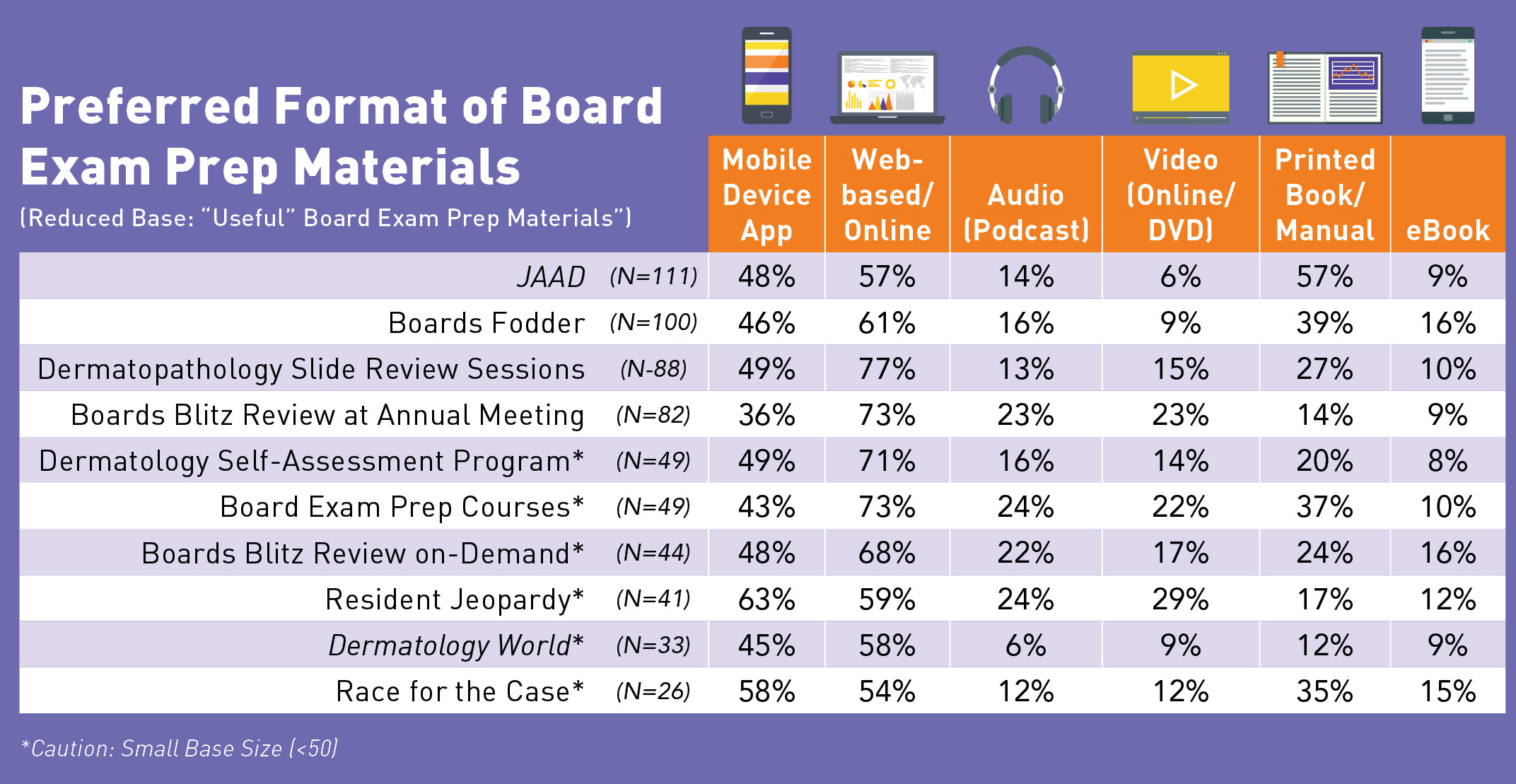
How would you prefer to access these resources when studying for Boards?

DermWorld>2019>November>Evolution of education>table1

According to a 2015 survey of Academy residents, online was the preferred format for almost all Academy board exam prep materials, with the exception that just as many respondents preferred the print version of JAAD as well as an online format.

Source: 2015 AAD Residents Survey

Digital vs. print

Roxana Daneshjou, MD, PhD, a final-year dermatology resident at Stanford University, remembers taking notes on paper in high school and college, although she has come to appreciate the ease and accessibility of digital notes. “I never took notes on my computer until medical school. In residency, I started primarily using digital books, which are all downloaded on my phone, computer, and iPad. I can now take ‘handwritten’ notes on an iPad, which are even searchable.” As a bonus, she likes that digital notes are friendlier for the environment.

When print texts first transitioned to digital formats, the digital version was simply an exact copy of the print version. Now, there are often perks to using digital formats, such as cloud-based access, the ability to take notes using a stylus, and quicker access to additional information through hyperlinked content.

“The internet as well as digital forms of lectures and textbooks have made a profound impact on education,” said Jean Bolognia, MD, professor of dermatology at Yale University and senior editor of the textbook Dermatology. “Gone are the multiple carousels full of Kodachrome slides, along with extra bulbs for the projector.”

On her phone, Dr. Bolognia has at least a dozen complete textbooks, including Dermatology, which contain thousands of pages. “The text and figures are surprisingly easy to view because platforms such as Inkling allow them to precisely fit the phone’s screen.” Another perk to digital platforms is the ability to have videos complement chapters on surgical and aesthetic procedures, she said.

Dermatologists-in-training: Outside the classroom

One of the biggest changes in medical school is that much of the learning now happens outside the classroom. Garcia accesses nearly all of his lectures online, allowing him to set the pace and style of his learning. Since the lectures are recorded, students have more flexibility in how they learn. “They can better focus on how to best optimize their time to prepare for the licensing examinations,” said Garcia.

“Medical students are not required to go to all classes,” said Ashish Bhatia, MD, a dermatologic surgeon and associate professor of clinical dermatology at Northwestern’s Feinberg School of Medicine. “The students tell me that there are a lot of video lectures on-demand. It’s a very Netflix world.”

“By having more independent study time, students are not connecting with their classmates as much as in prior years, until clinical rotations,” said M. Laurin Council, MD, associate professor of dermatology at Washington University in St. Louis and editor of the Academy’s Dialogues in Dermatology podcast.

“When you’re physically in a lab, you’re usually working in groups. When you are working with a group, you’re immersed in it,” Dr. Bhatia added. That immersion has been lost, in part, because of the barrage of distractions. “But somehow people adapt to that too, and they can function in that environment, although some still struggle.”

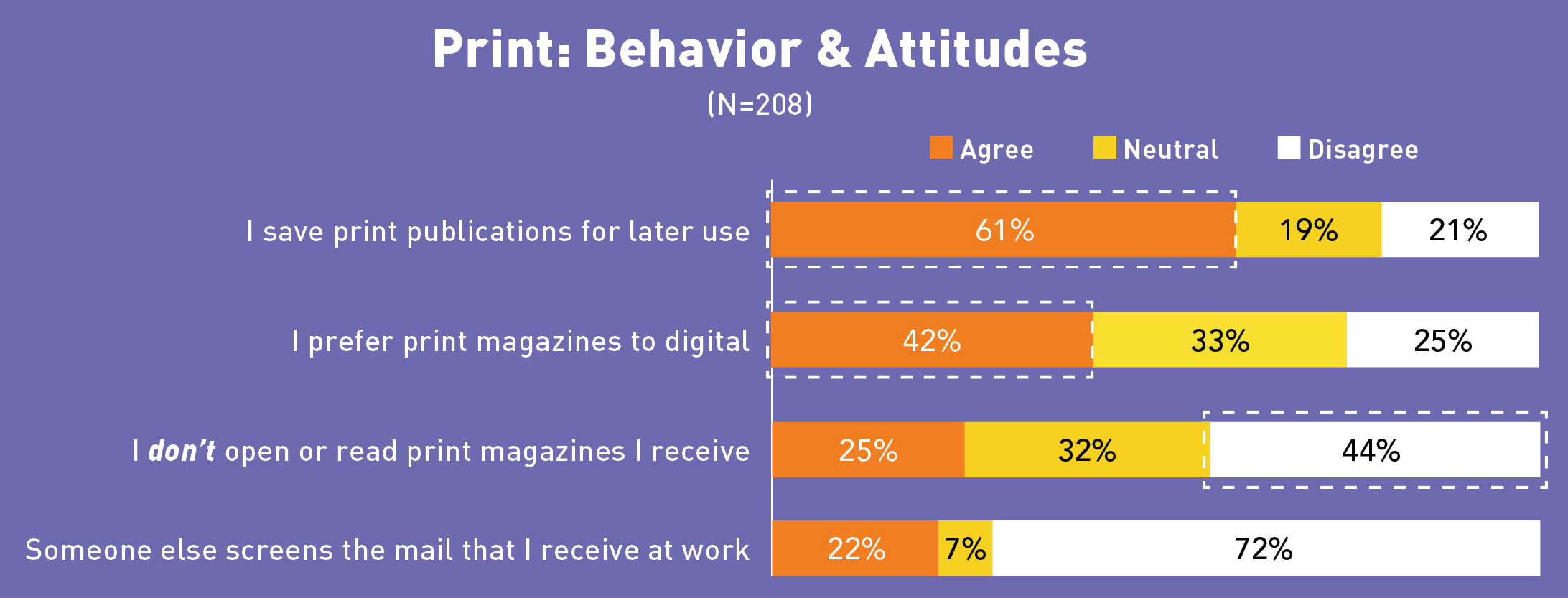
Indicate your agreement with the following statements.

DermWorld>2019>November>Evolution of education>table2

In the age of digital revolution, print publications still enjoy longevity with six in 10 young physicians saving them for later use. Four in 10 prefer print to digital, while only one in four do not open print magazines at all. While digital resources are gaining a hold in today’s educational and professional worlds, print is far from dead for Academy members.

Source: 2018 AAD Young Physicians Survey

The science of studying

For many students, gone are stacks of meticulously categorized notecards. Garcia and other early-career dermatologists use Anki, a free and open-source digital flashcard program that uses spaced repetition to make learning more efficient. With the proliferation of data available and the desire to increase the efficiency of studying, some students have analyzed how using specific exam-prep products correlates to performance on the boards or what an expected Step score might be, Garcia said. “With these technologic changes, there is an increased focus on numbers and percentages. All of these resources have ways to quantify your progress.”

Anatomy

Anatomy labs, often regarded as the prototypical medical school course, have also changed, said Dr. Bhatia. “Medical schools are increasingly employing prosection, in which the professors expertly dissect just a few cadavers and then have the students view the various structures.”

“Dissecting cadavers in the anatomy lab used to be a rite of passage in the journey to become a doctor, but I’ve heard some medical students say that they see little benefit in spending hours dissecting, especially when technology has added so much to the learning experience,” Dr. Bhatia noted. “Some students don’t even buy anatomy textbooks anymore and instead rely on class materials and 3D anatomy apps. These anatomy simulation apps can be viewed on a computer or tablet and allow students to visualize all the structures in the body at any angle and magnification. The apps allow students to remove layers of muscle, fat, and bone to better visualize the intricacies of underlying structures, which can be especially helpful in complex anatomical areas such as the head and neck.”

More medical schools are now adopting virtual dissection tables that can display life-size images of cadavers. These 3D virtual cadavers have been recreated based on actual body scans and real patient data, and loaded into a large touch-screen table. These virtual dissections offer students the ability to navigate around the body with ease and see organ systems from views that would be nearly impossible on an actual human.

However, “Feeling cadaveric tissue to appreciate the thicknesses and interrelationships has a lot of value — something lost in the digital world. The lab also allows students to experience variations in anatomy between many cadavers, which can be invaluable for learning and anticipating what will be encountered in the clinic and operating room,” Dr. Bhatia said.

In addition to studying anatomy, students can also learn surgical skills using simulations. Much of the training is performed on SimSkins, simulations that contain all the layers of skin — fat, muscles, arteries, everything, Dr. Bhatia said. “They are quite realistic. If you don’t design your closure correctly, the skin will buckle and dog ear just like on a real person. In that way, they are even more realistic than an embalmed cadaver which does not have life-like tissue elasticity and pliability.”

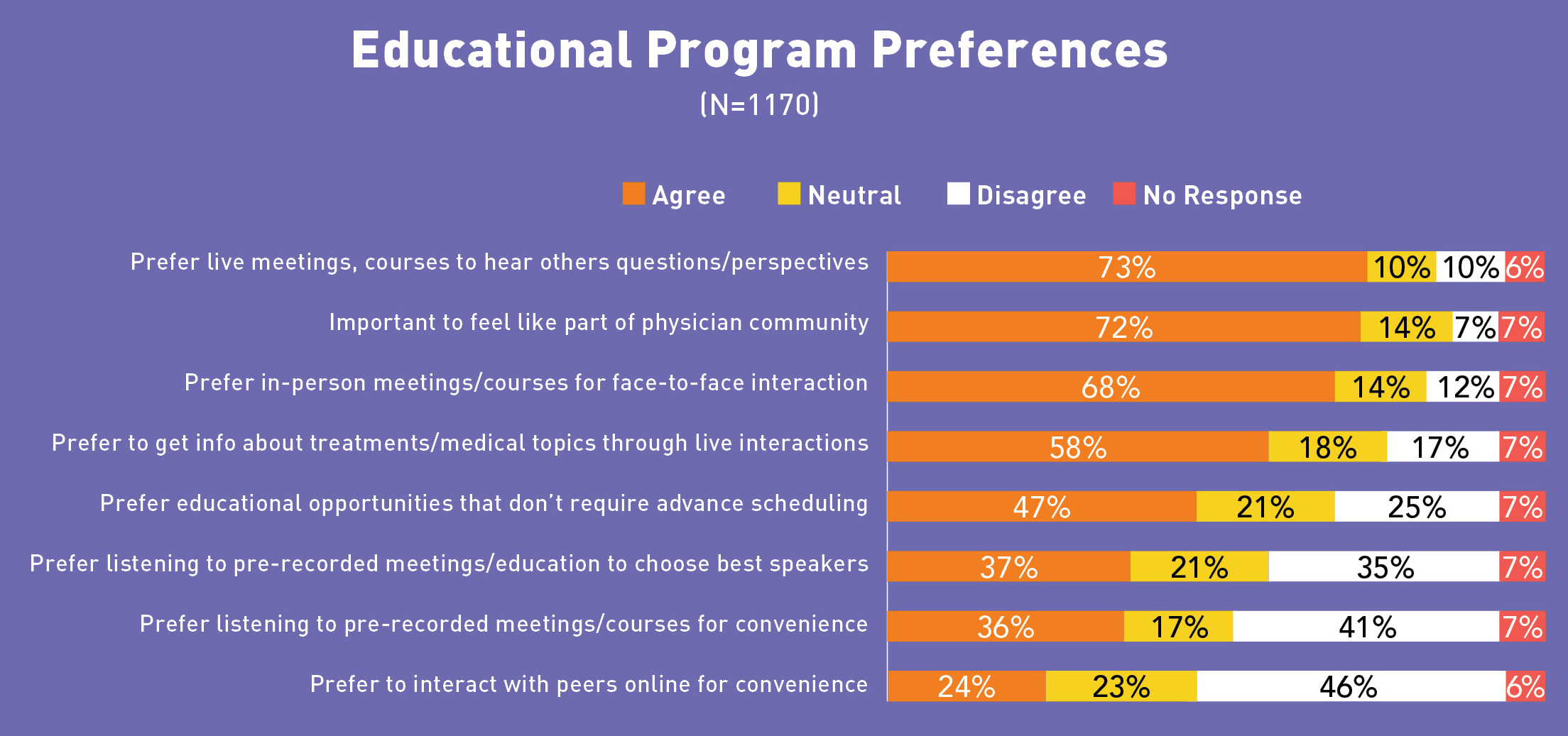
How much do you agree or disagree with the following statements about participating in educational programs?

DermWorld>2019>November>Evolution of education>table3


According to a 2017 Academy membership survey, most members preferred live and in-person educational programs for the face-to-face interactions, sharing of perspectives and treatment information, and the sense of community. 

Source: 2017 AAD Member Segmentation Survey

Teachers’ perspectives

“Classroom education has definitely evolved over the past few years,” Dr. Council noted. “When I attended the dermatology course as a medical student, our lecture hall was packed with medical students taking notes by hand. Today, when I give lectures to medical students, I am often surprised by how few students actually attend the lectures. The majority of students are using their time for self-study,” she said.

Dr. Bhatia has witnessed the changes in education as well. “Early on, when teaching residents and medical students, a lot of it was either didactic where you’re giving lectures, or Socratic where you’re asking questions. These modes of teaching are slowly going by the wayside.”

Now, much of the learning that happens is case-based, Dr. Bhatia noted. Once you have a solid foundation, case-based learning is a lot more fun, he said. Dr. Bhatia notes his enjoyment of taking the Academy’s weekly case-based CME question — Question of the Week. “It’s so simple and quick, but you remember it.”

Kevin Pierce, MAT, the Academy’s manager of digital learning, refers to this as micro-learning, and members are demanding this style of learning to fit not only their mobility but their busy schedules. “The difference between a medicine and a poison is in the dose. The same applies to learning activities. The Academy strives to administer just the right amount of educational content to satisfy member needs, whether in smaller doses, like Question of the Week, or larger ones like our teledermatology series.”

Multitasking

With multitasking, there must be a delicate balance between adapting to this faster-paced digital age and carving out time to comprehend and retain more complex material. “In this world of overstimulation and multitasking, attention spans shrink, and case-based learning fits into this digital environment very well,” Dr. Bhatia added. “I may not want to go read in detail about all the porphyrias, but seeing a specific case, it will remind me of the highlights, which helps me keep it in my differential.”

“Multitasking is overrated — easy when talking on the phone and stirring tomato sauce, but not so easy when thinking about a differential diagnosis and potential therapies,” said Dr. Bolognia. “Also, when learning new information, there is a major distinction between reading and synthesizing, with the latter requiring focused blocks of time.”

However, Dr. Council, a full-time academic Mohs surgeon and mother of five, finds multitasking essential to getting through each day. “I love that I can have Dialogues in Dermatology on during my commute to work and in the background as I cook dinner for my family.” Additionally, each podcast is short enough to maintain attention and provides capsule summaries and take-home points to reinforce learning, she said.

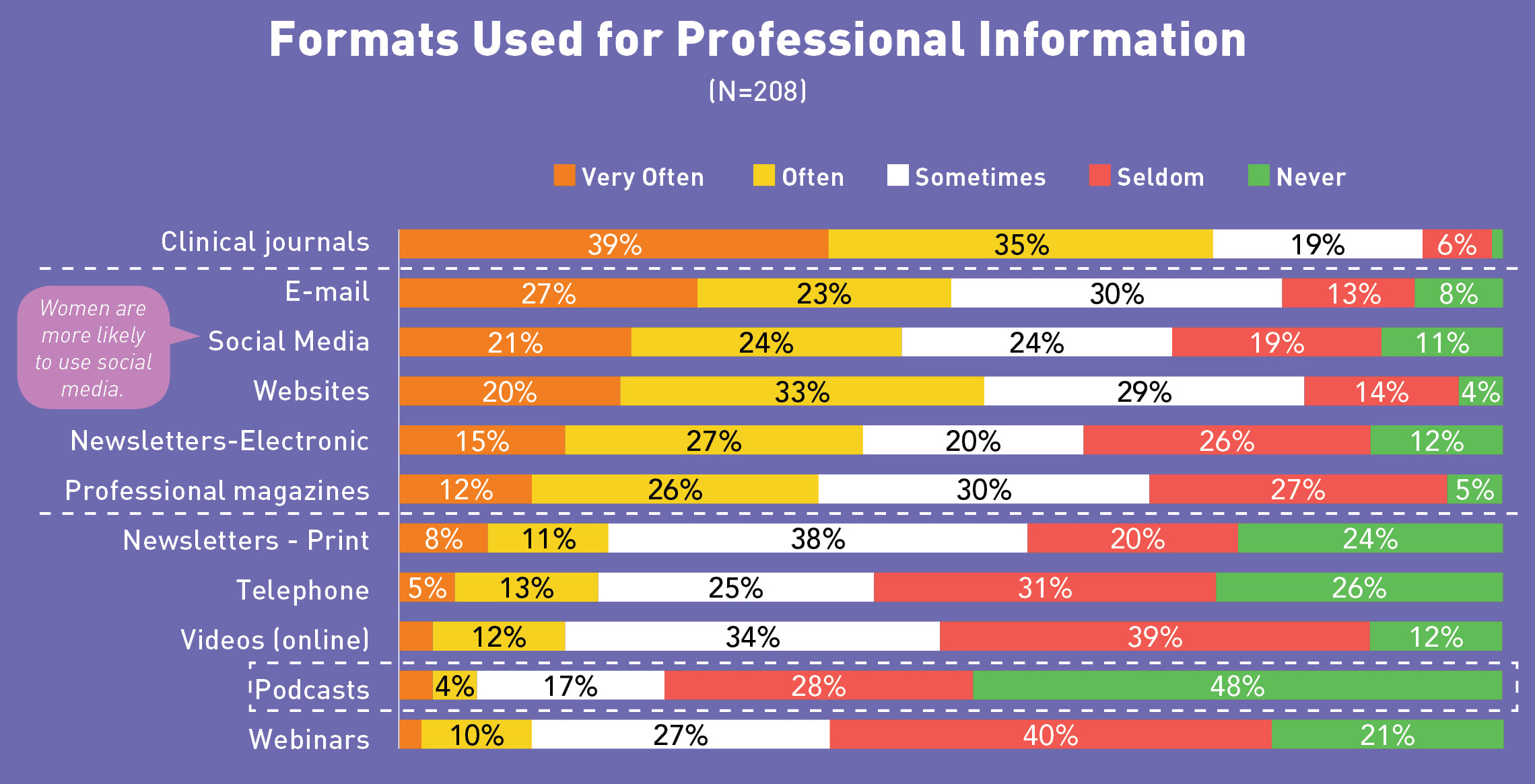
How often do you receive or seek professional information in these formats?

DermWorld>2019>November>Evolution of education>table4

According to a 2018 Academy survey of young physicians, clinical journals are used most frequently for professional information followed by email and social media. Webinars, podcasts, and videos were used infrequently. Despite low usage by young physicians, they largely agree that podcasts and videos are a good way to share educational information and favor its convenience, as seven in 10 multitask while listening to or viewing podcasts/videos. 

Source: 2018 AAD Young Physicians Survey

Augmenting the brain

For Art Papier, MD, the founder of the clinical decision support platform VisualDX and a professor at the University of Rochester, his primary goal is to reduce the clinical variability in medicine using technology at the point-of-care. With the proliferation of so much information and data, Dr. Papier believes physicians need to augment their brains to provide better patient care.

He likens this need to pilots flying a 747 aircraft. Without all the added technological advances, a pilot could not operate a 747. It’s too complex, he said. At the time the Wright brothers were flying in the early 1900s, medicine was very different. There was much less information and fewer resources at a physician’s disposal, he said. “Now we have all these advanced therapies and testing and we’re still trying to keep all of this information in our brain — an impossible thing to do,” Dr. Papier said.

The explosion of medical knowledge no longer allows physicians to keep in their mind all knowledge that is necessary to provide quality patient care. It is estimated that more than 600,000 articles are published in biomedical literature every year. If a student attempted to keep up with the literature by reading two articles per day, in one year this individual would be more than 800 years behind (Trans Am Clin Climatol Assoc. 2015; 126: 260–270).

Physicians in the age of Google

Not all decisions need computers for guidance, Dr. Papier said. Most of the time common problems present and simple pattern recognition is enough. “When an immunosuppressed oncology patient comes in with a rash, and the oncologist has just started him on three new medications, some of which you’re totally unfamiliar with, your question is: Does that medication cause this kind of rash? You likely don’t have that answer in your brain.”

For many physicians there is a discomfort with looking something up in front of a patient for fear it may diminish their authority. Dr. Papier notes the challenge of getting students and residents to use support tools, like VisualDX, during training so that in practice they’re comfortable looking things up in front of the patient. He wants to educate students and residents to use information so they’ll be lifelong learners and users of information in the exam room to improve the visit.

Before a patient even steps foot into an exam room, many have already been on the internet searching their symptoms, diagnoses, and treatments. “It’s imperative that doctors have professional tools they can use that will palpably demonstrate to patients that their doctors have access to the latest information and are continually learning and up on the most recent advances,” he said.

“Physicians augmenting their knowledge with professional tools are improving the quality of their decisions and gaining trust from patients. We are living through a historic transformation from memory-based decisions to augmented information in the exam room,” Dr. Papier added.

However, “Even though so much information is available at your fingertips, it is not a substitute for foundational learning and knowledge assimilation,” Dr. Bhatia noted. “Studying and keeping up with the literature as a student, resident, and a practicing physician is essential in order to be at the top of your game. I want the physician taking care of me and my family to have a solid foundation of knowledge and be able to quickly make an accurate diagnosis and know the treatment options. It’s okay to confirm doses and check for zebras through references, but in an emergency, do you really want your doctor looking up information on their phone?” Medicine remains an art as much as it is a science, said Dr. Bhatia. “Having more foundational knowledge in your head allows you to spend time in the clinic with more experienced physicians learning the art of medicine rather than looking up foundational knowledge.”

The power of social media

Social media has become a powerful tool for today’s physicians. “To keep up with the literature during medical school, I would often go to the websites of journals to see what the latest papers were. Before that, I would occasionally open a physical journal,” said Dr. Daneshjou. “Now, I get the latest updates on Twitter, where I follow all the major journals.” With Twitter, the accessibility of information can be immediate.

Despite studies indicating a lack of critical analysis and engagement with digital information, Dr. Daneshjou believes Twitter has amplified her ability to learn and grow as a physician. Dr. Daneshjou, founder of @DermatologyJC journal club on Twitter, uses the journal club to communicate with and learn from physicians across the globe.

“After I read a paper, I can look at Twitter to see what people are saying and join the intellectual conversation about the paper, which allows me to think more deeply about what I have read and what it means,” said Dr. Daneshjou. “Digital learning tools, such as Twitter, do not replace critical thinking. In fact, they should enhance critical thinking — by allowing intellectual debate and discussions with those who challenge your assumptions,” she added.

Technology can easily connect us with experts in the field who may be time zones away, Dr. Council added. “The disadvantage is that some physicians no longer feel the need to attend specialty society meetings because CME credit and learning opportunities are so readily available. There is something special about physically being in the same room with someone else, face to face.”