By Allison Evans, assistant managing editor
Several years ago, an AADA staff member spoke with a state legislator about ways to increase patient access to health care resources. The legislator indicated that he wanted to introduce a bill that would expand the scope of practice for pharmacists to allow them to prescribe certain kinds of medication. When questioned about the pharmacists’ asks, the legislator couldn’t recall specifics, he simply remembered the pharmacists’ pervasive presence, giving credence to the belief that showing up is half the battle.
“It’s really hard when legislators see pharmacists as a way to address access. It makes physician advocacy even more challenging,” said Lisa Albany, JD, director of state policy at the AADA. Indeed, pharmacists and other non-physician providers have a compelling case at a time when legislators are concerned about increasing patient access to health care. It is imperative that physicians mobilize to present an equally compelling counterargument about the importance of physician-led care teams and patient safety, and who better to present that argument than physicians themselves? At its core, this is grassroots advocacy — when constituents appeal directly to representatives.
Dermatology World explores how the AADA and its members have paved a path of advocacy success that has resulted in real-world changes to the way physicians practice and patients receive care. Additionally, it will provide simple steps members can take to continue the momentum and strengthen the voice of dermatology as well as the individuals that make up the specialty.
What does success look like?
Groups like the pharmacists are successful because they execute multipronged, prolonged, and consistent grassroots efforts, Albany said. “We encourage our physicians to get involved in grassroots mobilization and reach out to their legislators and develop relationships with them so they can better understand the value of dermatology,” she said. Policymakers may not remember every detail of a dermatologist’s asks; however, the goal is to be front-of-mind.
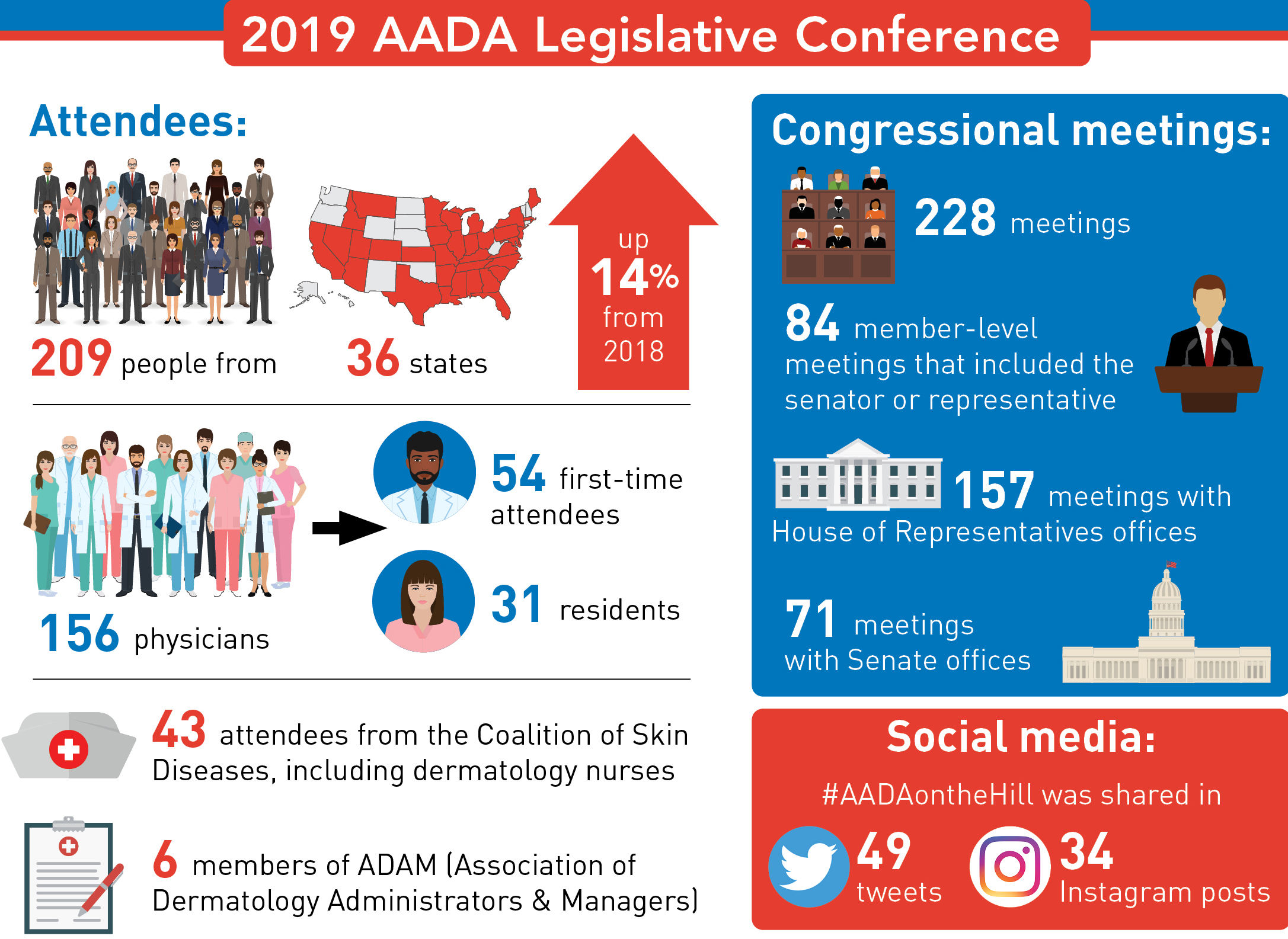
Sabra Sullivan, MD, PhD, former chair of the Academy’s Government Affairs and Health Policy Council (GAHP), has witnessed the power of grassroots efforts at the AADA Legislative Conference. “At our Legislative Conference, dermatologists, patients, patient advocates, nurses, and practice administrators learn about the most pressing issues facing dermatologists and their patients, and then we go to Capitol Hill to talk about those issues with members of Congress. Those meetings make a big difference in advocating for our patients and our practices.” See the sidebar for a list of previous successes resulting from AADA Legislative Conference asks.
2020 Academy advocacy priorities
Learn more about the Academy’s 2020 advocacy priorities at www.aad.org/member/advocacy/priorities.
Indoor tanning
One of the biggest success stories that the Academy has had with grassroots advocacy is the indoor tanning legislation and regulations that have been implemented both on the federal and state levels, said Massachusetts dermatologist Mary Maloney, MD, a previous AAD/A secretary-treasurer and board member as well as the recipient of the Academy’s 2020 Advocate of the Year Award.
While the World Health Organization’s International Agency for Research on Cancer (IARC) has deemed sunbeds and sunlamps “definitively carcinogenic to humans” for more than 10 years, changing public practice and health policy has remained a long-running battle for the Academy.
Originally, tanning booths were in the same class of device and had the same federal oversight as tongue depressors, said Dr. Maloney. “The tanning association was advertising that tanning booths were good because they would stimulate vitamin D production, which we, as dermatologists, knew was false.”
“We went to the Justice Department armed with crates of materials and evidence of the tanning association’s false advertising claims.” In the end, the federal government agreed and ordered the association to cease talking about the benefits of tanning, and that, in fact, there were no known benefits of tanning, which was a huge victory, Dr. Maloney said.
Mary Maloney, MD, named Academy’s Advocate of the Year
This year, Mary Maloney, MD, was selected as the Academy’s Advocate of the Year in recognition of her outstanding commitment to grassroots advocacy on behalf of the specialty at the state and federal level. The award recognizes outstanding grassroots advocacy efforts by an Academy member who undertakes a significant amount of advocacy endeavors at the state and/or federal level on behalf of the specialty.
Dr. Maloney is applauded for her advocacy efforts on issues such as skin cancer prevention, access to dermatologic care, and pharmaceutical affordability. As the founding chair of the AADA’s State Society Relationship Committee, Dr. Maloney is also acknowledged for her leadership efforts in the AADA’s work toward state society development and relations. The 2021 application for this award will open in the fall. See www.aad.org/member/career/awards/advocate.
The FDA listens…and acts
In 2014, the U.S. Food and Drug Administration (FDA) issued a final rule that strongly recommended against the use of tanning beds by minors under 18. Additionally, it called for strengthened warning labels on indoor tanning devices and reclassified tanning beds and sunlamps from Class I to a Class II medical device — indicating that their use poses a “moderate to high risk.”
“It’s not one thing,” Dr. Maloney affirmed, “but a huge effort to make these changes over a long period of time. Sustained effort is necessary.”
In December 2015, the FDA proposed an age restriction on indoor tanning for minors under the age of 18, as well as a risk acknowledgement form that all adults must sign before using indoor tanning devices. “The federal government chose not to impose this legislation, and so it fell to the states,” said Dr. Maloney. The grueling efforts of many, including Academy members and staff, patients, and other organizations, have paid off. Since 2012, 23 states have enacted laws prohibiting minors from indoor tanning.
Not what the doctor ordered?
Learn about how pharmacists assume a greater role in dermatology patient care at www.aad.org/dw/monthly/2020/june/not-what-the-doctor-ordered.
Scope of practice
Over the last few years, pharmacists — and other non-physician practitioners — have been successful in incrementally expanding their scope of practice to include biosimilar substitution, vaccine administration, and other patient care functions. Additionally, many scope regulations have been temporarily loosened to address the COVID-19 pandemic, and many of these non-physician groups are using the pandemic as an appeal for making the changes permanent, Albany said.
In May, the AADA took on nurse practitioners in Louisiana who were attempting to make these loosened regulations permanent. “In response, the Academy sent a grassroots alert to members. Louisiana physicians did a really nice job of responding to the alert, and as a result, the bill wasn’t heard, although it is still under negotiation,” Albany noted.
Scope of practice, in particular, is a constant battle. The successes are often temporary and, thus, require sustained advocacy efforts. Because most scope regulations are decided at the state level, it’s critical to engage with state-level grassroots alerts.
“In 2019, there were over 70 bills in states across the country relating to non-physician scope of practice expansion that could impact dermatology,” said Indiana dermatologist Carrie Davis, MD, chair of the AADA Grassroots Advocacy Task Force. “Through the work of the AADA and the grassroots efforts of our members, state dermatology societies and medical societies, nurse practitioners did not gain independent practice in any state in 2019.”
“In January, more than 1,000 Academy members used the AADA’s Advocacy Action Center to send letters to CMS asking them to preserve physician-led, team-based care, as they considered eliminating regulations around scope of practice laws,” Dr. Davis said. “We’re still waiting on the final rule, but we had a great response from our members!”
AADA Advocacy Action Center
Taking action is easier than you think! Send a letter to your representatives at takeaction.aad.org.
It’s all about grassroots
“Lobbyists certainly have an important role in getting dermatology’s message to Capitol Hill. But members of Congress really want to hear directly from constituents about how their districts are affected by different health care policy issues,” said Susie Dumond, the Academy’s grassroots and congressional advocacy specialist.
“The goal of the AADA’s grassroots advocacy program is to educate our members about important policy issues that may affect their practice and patients, and then empower them to advocate on those issues directly to their legislators in Congress, as well as federal agencies and state and local governments,” Dumond said. “In order to make a real difference in policy that affects dermatology practices and patients, it takes a coordinated effort between AADA staff lobbyists and grassroots advocacy from our members.”
AADA grassroots action alerts
“When policy issues arise, you may receive an AADA grassroots action alert via email,” Dr. Sullivan said. It only takes a few minutes to send a letter to your member of Congress, but you can take it a step further. “After you send the letter, consider calling or emailing your representatives and their staff to tell them in your own words what the issue means to you. You can also forward the email on to other AADA members and ask them to take action as well.”
2019 was a banner year for the AADA and its members, Dr. Davis said. “More than 700 AAD members contacted legislators through the Action Center and sent almost 2,500 letters to Congress, state legislators, or agencies such as the CDC and FDA. During last year’s Legislative Conference, we talked about many bills in Congress that addressed pharmaceutical access and affordability. Members sent over 1,400 letters on drug pricing to legislators as well. As a result, we saw the passage of the CREATES Act, which helps generic manufacturers access drug samples in order to make generic medications to increase competition and lower drug prices.”
Most recently, the Academy’s Action Center has asked members to tell Congress about their experiences with COVID-19 in their districts, Dr. Davis said. Members have heeded this call and have sent 675 letters as of May. “This input will help determine what goes into the next wave of COVID-19 relief legislation.”
While the AADA Advocacy Action Center is for Academy members only, there is also a public Dermatology Grassroots Advocacy page (www.aad.org/grassroots) that provides opportunities not only for dermatologists but for others, including patients, patient advocates, nurses, and practice administrators to advocate on important issues.
The public grassroots page highlights one issue at a time. “I encourage you to share this page with anyone invested in making treatment and prescription drugs more affordable, including health care professionals, patients, family, and friends,” Dr. Sullivan said.
Join the 2020 AADA Virtual Legislative Conference Sept. 15, 2020
Help bring dermatology issues to Congress from your home! Registration opens Aug. 10. Learn more at www.aad.org/member/advocacy/leg-conference.