
By Allison Evans, assistant managing editor
After all the United States (and the world) has undergone this year, it’s hard to imagine the import of one single day — Tuesday, Nov. 3, 2020 — the day of the 2020 U.S. elections. The COVID-19 pandemic struck the country at a time when political, socioeconomic, and racial divisions had left people shaken and wondering if these craterous divides could be bridged. Many industries have been crippled by the pandemic — including health care.
A wide variety of surveys conducted by organizations like Pew Research Center, Gallup, Harvard University Center for American Political Studies, and others, have narrowed in on what Americans care about most as the country prepares to cast its votes in the 2020 election: health care. In nearly every poll, health care is ranked as the top concern, followed by (order varies by survey) the economy and jobs, climate change and the environment, immigration, terrorism and national security, and gun control policy.
Regardless of who wins the presidency or which party controls Congress come January 2021, so many questions will remain: “Is there going to be a surge in the coronavirus? Is the economy headed toward recovery or will the pandemic continue to wreak havoc on jobs, schools, and families?” said Kelley Pagliai Redbord, MD, chair of the American Academy of Dermatology Association (AADA) Congressional Policy Committee. “It’s going to be a very tumultuous time for the world, for our country, and for dermatologists who will continue to prioritize patient care and safety amidst a continued array of hurdles and roadblocks.”
“Some dermatologists have closed their practices, some have intentionally cut back on the number of patients they see, but we have all prioritized the safety of our patients throughout this pandemic. The real question for dermatologists is how we, as a profession, focus on the challenges ahead in the face of economic recovery. The presidential election will certainly impact how we move forward as a country, but it is equally important that we focus on advocating for our profession in the midst of extremely difficult economic times.”
This month, DermWorld explores the significance of the 2020 U.S. election — encapsulated within a pandemic — and how both events may impact the future of health care policy. With a large swath of the country unemployed and either uninsured, or afraid to seek medical care because of fear of cost or the coronavirus, the impact on the health care system has been catastrophic, and its full effects remain to be seen. “Even if the pandemic ended today, the effects of COVID-19 on the health care system would still be lingering because practices will still be struggling,” said Shawn Friesen, director of legislative, political, and grassroots advocacy at the AADA. “The election won’t change that.”
Looking at the possibilities
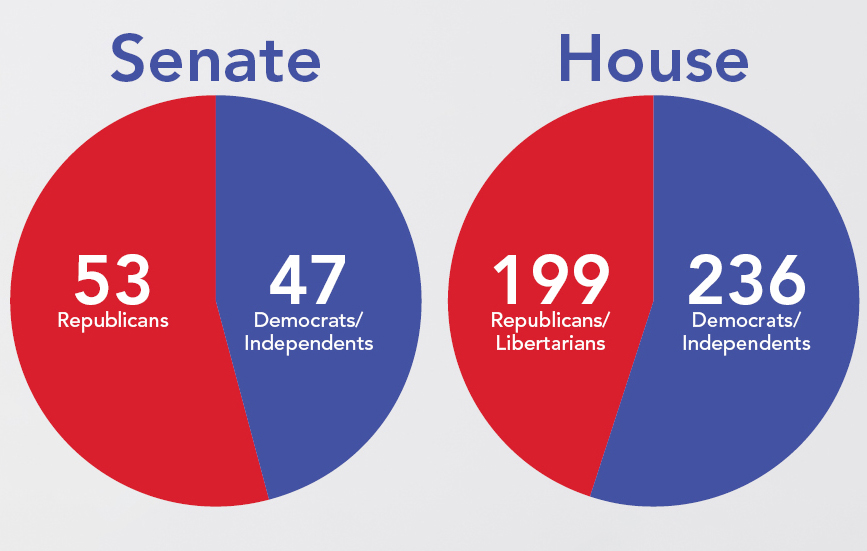
There is much speculation and prognostication about which parties will maintain, win, or lose control of the House and Senate. After the 2018 midterm elections, Democrats seized control of the House, leaving Congress politically at odds once again.
The question is whether Democrats will maintain this control and, perhaps, even gain control of the Senate. Is it possible for Trump to win the presidency while Democrats take control of Congress? Will the party of the winner of the presidential election determine congressional party majorities? In politics, the only sure thing is that there is no sure thing, remarked Bruce Brod, MD, chair of the AADA Council on Government Affairs and Health Policy.
The future of health care
The AADA’s Congressional Policy Committee has been discussing the AADA Health System Reform Principles and what that might mean for dermatologists, Dr. Redbord said. If President Trump is re-elected, he obviously will not support a single payer system. While Biden has a plan to expand health care access through some type of expanded public options for coverage, Dr. Redbord noted, he hasn’t clearly come out in support of single payer proposals either.
“Health care reform in a Biden Administration might look more like increasing subsidies for the Affordable Care Act (ACA). It’s not just dependent on the election, but it’s also dependent on public sentiment,” Dr. Brod said. How much will the economy suffer from the pandemic? That could drive public sentiment, which would then influence the behavior of the parties in power, he said.
“If we have a Biden presidency over a Trump presidency and a Democratically controlled Senate, we may see a shift in the current approach to health care reform,” Dr. Brod said, “but it’s hard to predict that.”
The economic health of the country may not be conducive to making significant changes to our current health care system. Another challenge is that if the economy still hasn’t recovered, Medicaid will need to be shored up, said Friesen. “If funds are being funneled into Medicaid, there will be fewer funds available to deal with other health care coverage expansion proposals.”
Friesen wonders, however, if the pandemic may create a climate in which politicians are compelled to create bipartisan bills. “If Democrats hold the House and win a small majority in the Senate, and Biden wins the presidency, maybe they will try to find a way to shore up the ACA and peel away some more traditionally moderate Republicans to their side,” he said. “This will largely be driven by the ratio of Democrats to Republicans in each chamber and the will of each side to cut a deal that benefits the American people who have become weary of tribal politics. I think it’s unlikely because people are so entrenched, but the period following presidential elections can sometimes be ripe for members of both parties to want to move past the election and get things done.”
Universal health care
Learn more about what health care for all in the U.S. could look like.
Academy priorities shift amid a pandemic
For years, the Academy has prioritized fair reimbursement for dermatologists and various forms of regulatory relief. “We want to continue to push for prior authorization and step therapy reforms, although priorities must remain fluid given that we are in the midst of a global pandemic,” Dr. Redbord said. Regardless of which party wins the White House in November, “We’re still going to have our own priorities and will continue trying to move the needle. We still have to push to protect our other policies despite the uncertainties and challenges in the world.”
“We’re also focused on Medicare reimbursement and ensuring our members continue to have access to relief funds, whether it’s through the Paycheck Protection Program or through the Provider Relief Fund,” said Friesen. “Beyond that, we will continue to advocate to make sure that our members are receiving the reimbursement they need to cover current costs and are able to continue providing care to their patients.”
“When the political landscape shifts, although the priorities change, it creates opportunity,” Dr. Brod said. In the current administration, physicians have seen the diminution of regulatory requirements as seen in the 2017 CMS Patients over Paperwork initiative, he explained. At the same time, the trend toward loosening regulations can impact other Academy priorities, such as indoor tanning. “If there’s a political shift come November, it may elevate the ability to regulate tanning devices to an achievable priority.”
COVID-19 has inevitably forced some Academy priorities to the backburner for a time as the Academy advocates on more pressing issues resulting from the pandemic, including financial relief and liability protection. Although, as Dr. Redbord points out, “We still have patients who cannot access medication because of prior authorization or step therapy; that doesn’t change. This is still important to us on a day-to-day basis.” In many ways, it’s more important now because a lot of practices are operating with fewer staff than they did pre-coronavirus, she said. “Who’s going to do the prior authorizations now, and how much time will it take?”
How is the Academy advocating for you?
View the Academy’s advocacy priorities.
Federal issues
Medical liability
“As dermatologists open their practices and begin seeing more patients in the office, they need to be cognizant of the potential for spreading the virus,” said Robert Portman, JD, MPP, in the August Legally Speaking column. “The federal government and several states have enacted certain temporary legal immunities for providers treating COVID-19 patients. However, these immunities do not extend to health care providers that are not directly treating COVID-19 patients, thereby opening the door to potential liability for certain dermatology practices if a patient alleges that they contracted COVID-19 while in the office or during the course of treatment for a non-COVID-19-related illness.”
Portman advises that physicians minimize potential liability by ensuring that they have the proper policies and procedures in place to prevent COVID-19 infection or address a potential infection. It is also important that patients are properly informed of, and consent to, the COVID-19-related risks of receiving non-emergent medical care before they come into the office.
On July 27, Senate Republicans unveiled the “HEALS Act” to provide additional coronavirus relief aid. One of the main aspects of the proposal was liability protection for businesses. The proposal provided businesses, schools, and other institutions with favorable presumptions of good faith compliance with safety standards and guidance. It would require plaintiffs to prove gross negligence or willful misconduct to establish liability.
The issue of medical liability coverage around the pandemic has become an important issue, said Friesen. For example, if a patient was scheduled to be seen but was unable to because of the pandemic, and the patient’s condition worsened, it’s unclear whether physicians can be held liable for pandemic-related circumstances outside their control.
“Not only are physicians concerned about potential liability suits from patients, they are also concerned about the potential of their employees being exposed and contracting the virus as well,” Friesen explained. “What if a patient is sitting in the waiting room and argues they contracted the virus there? The issue of providing liability protection tends to lean Republican, but not monolithically so, as there are Democrats, particularly with a small business background, that are mindful of the realities facing small businesses as well,” he added.
Managing your business during a pandemic
Confused about all the financial relief programs available to physicians? Learn about the different programs.
Telemedicine
Throughout the pandemic, the Academy has also advocated for protecting full and fair reimbursement for telehealth services. Various bills have been introduced that would make permanent some of the temporary changes that CMS has initiated in its telehealth coverage during the COVID-19 pandemic. There is much bipartisan support for bills that would eliminate most geographic and originating site restrictions on the use of telehealth for Medicare patients as well as allowing telehealth visits to be conducted in a patient’s home, among other changes.
“Support for or interest in telemedicine expansion is often driven more by what a senator’s or representative’s state or district looks like — whether that includes underserved urban areas or rural or remote communities — as opposed to whether they’re a Democrat or Republican,” Friesen explained.
CMS Administrator Seema Verma made clear that things cannot simply return to how they were before. “As the country re-opens, CMS is reviewing the [telehealth] flexibilities the administration has introduced and their early impact on Medicare beneficiaries to inform whether these changes should be made a permanent part of the Medicare program,” she said in a July Health Affairs blog post.
“It’s a challenging time for all physicians,” said Dr. Redbord, a Mohs surgeon, “but patients still have melanomas and serious skin cancers that need to be treated. We need to make sure patients feel safe when they walk into our offices because they need to be treated. While there is no legislation that can provide patients peace of mind, we can do everything we can to focus on patient health and safety.”
Drug pricing
If President Trump is re-elected, most experts agree that he will continue to take on drug pricing as an access issue. “There’s probably bipartisan support for addressing drug pricing,” added Dr. Brod, “although the approaches of the parties would be different.”
Both parties have been very interested in how to attack the issue of drug pricing, Friesen said. “The Trump administration has been very aggressive on the drug pricing issue, and Democrats in the House passed aggressive drug pricing legislation as well.”
Prior authorization appeal tool
The Academy has created a customizable, clinically specific tool to allow practices to easily download prior authorization appeal letters for select dermatologic drugs and diseases. Find it here.
State issues
Since the midterm elections, the state landscape has not dramatically changed, said Lisa Albany, JD, director of the state policy at the AADA. “We saw a high turnout for the 2018 state elections, and the Democrats had some significant wins, although Republicans still control the majority of legislative seats.” According to Ballotpedia, there are a total of 7,383 legislative seats, 52% of which are controlled by Republicans. Currently, 29 states have Republican-controlled governments, and 11 states will hold gubernatorial elections (seven of which have Republican incumbents).
While Albany expects the 2020 election turnout to remain high, she wonders about the impact of the pandemic on voter turnout. As of July 2020, seven states have a universal vote-by-mail system in which a ballot is mailed to every registered voter (California, Colorado, the District of Columbia, Hawaii, Oregon, Utah, and Washington). Forty-six states now offer access to some form of mail voting to all voters, according to a report from the nonprofit Open Source Election Technology Institute, although in some states, residents will have to apply for a mail-in ballot, which could affect turnout.
Scope of practice
At the state level, one of the biggest priorities right now is dealing with temporarily loosened scope of practice regulations to increase access to care during the pandemic, said Jill Allbritton, MD, chair of the AADA’s State Policy Committee. She believes that the state-level elections will determine the future obstacles and successes Academy advocacy efforts will face. “A lot of it has to do with how much health care knowledge elected individuals have,” she said. “Are they able to look at studies and critically interpret the evidence to determine if having other clinicians provide dermatologic care actually saves money and helps patients?”
There is much conflicting data in this area, so having a background in health care is an advantage — yet another reason dermatologists are needed in this fight. “We need to demonstrate that extensive training is required to ensure proper patient care,” Dr. Allbritton said.
While scope has always been difficult to argue with solid data, Albany discusses how the loosened scope regulations have created an even more difficult situation for the Academy. “It becomes hard to argue to legislators and say, ‘Well, it needs to go back to the way it was.’ And it’s the same thing with telemedicine.” Ultimately, the Academy will continue to argue that in light of the pandemic, it’s even more critical to have a physician-led team now with critically ill, complex patients being seen and so much that is still unknown with the virus. “Unfortunately, right now, I’m not sure if there is enough data to demonstrate that argument,” Albany said.
Telemedicine
Access to telemedicine, especially for people in rural areas as well as the elderly, who may have trouble with devices, is also an important issue at the state level, as individual states have differing levels of telemedicine regulations, support, and funding. While Dr. Allbritton believes a federal response is needed to address the issues, she’s unsure whether that’s going to happen, or when.
While federal bills have been introduced to make some of the emergency changes permanent, these do not apply to individual states, who have their own telemedicine legislation. “Are we going to continue telemedicine? Is it going to be reimbursed? At what rates is it going to be reimbursed? It’s still very much up in the air,” Dr. Allbritton said.
“Most of the issues that the State Policy Committee would be addressing are probably going to be put on the backburner by state legislatures who are going to be dealing with the pandemic and budget shortfalls,” Dr. Allbritton noted.
“We’ve been working on many priorities over the past few years, including sunscreen access, indoor tanning, and compounding. However, everything has been upended by the pandemic, so some things must give for a time to address the pressing issues,” she said.
Working with both sides of the aisle
It’s reassuring that Academy members and staff have been successful working with both sides of the aisle, said Dr. Brod. “We have good relationships with key Democrats and key Republicans.” Because the political landscape is continually shifting every few years, individual relationships are critical, Dr. Brod said. Political majorities come and go; nothing stays the same, he said.
What we can take from these struggles, Dr. Brod said, is the importance of finding common ground and building relationships. “Don’t get bogged down in the fact that you may not agree on everything. You may not even agree on most everything. Despite political differences, I think we have a lot more common ground than we might realize, even with members of the other party.” It’s important to bring that to light, he said, because you never know who’s going to be in power every two-year cycle. “People tend to view politics as a team sport and say I’m a fan of this politician or that politician. But the important thing is to be a fan and to be engaged in the political process,” he said.
Regardless of who wins, Dr. Redbord said, it may not matter. “As dermatologists, we’re going to focus on being able to treat patients safely throughout this pandemic, getting practices back up and running safely, and ensuring our members have access to the resources they need.”