












Mastering dermatology

By Warren R. Heymann, MD, FAAD
March 19, 2025
Vol. 7, No. 11
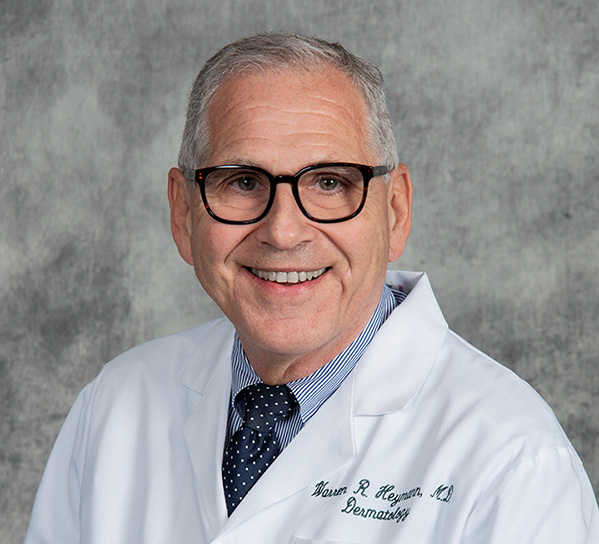
Dr. Heymann’s Master Dermatologist Award acceptance speech
Good afternoon, everyone.
Thank you, Dr. Desai and the American Academy of Dermatology. Receiving the Master Dermatologist award is the honor of a lifetime. To be added to the list of previous recipients of this award — genuine luminaries in dermatology — is exceptional.
This award is not mine alone — it is shared with my mentors and colleagues who have supported my journey — Michael Fisher at Einstein, Gerry Lazarus at Penn, and Ed Viner at Cooper, who set the foundation for growth. A special thank you to my career-long associates at Cooper, Steve Manders and Naomi Lawrence, who helped found and continue our program. A heartfelt thank you to my students, residents, patients, partners, and associates at HMGS Dermatology, Cooper, and Penn from whom I am always learning. Thanks to the AAD for allowing me to work for this glorious organization over the years.
This achievement would not be possible without the love and support of my wife of 42 years, Ronnie, and our daughters Andrea and Deborah. The time I have invested in my career has come at their expense — always a Faustian bargain.
How did I get here? In high school, I declared I wanted to become a broadcast journalist, emulating Eric Sevareid. My mother said, “Warren, be real — you don’t write very well and are not that good-looking. Be a doctor first — then write.” In medical school, when I told my parents that I decided to go into dermatology, I did so hurriedly, without giving them a chance to respond. With time they learned that dermatologists are real doctors. I know that they would be proud today.
Next week at clinic I will chuckle when confronted with diagnostic and therapeutic conundrums that befuddle me, thinking to myself, “Some master you are!” Dermatology is too dynamic and humbling for anyone to master it. It is the challenge and commitment in striving to master dermatology when our patients benefit the most. It is in that spirit that I will always cherish this award.

Further thoughts on becoming a master clinician
The following is from the Department of Internal Medicine at the Carver College of Medicine at the University of Iowa. (1) It is applicable to dermatology (or any discipline). I strongly suggest that any clinician interested in mastering their field read the entire article.
Master Clinicians are physicians who make lifelong commitments to caring for patients and educating young and future physicians. They spend the majority of their time teaching while simultaneously providing excellent direct patient care. They can teach effectively all aspects of physician development to a broad range of learners. They employ all available teaching and evaluation modalities, from the traditional to most cutting-edge, embracing innovative methods as opportunities to teach more effectively. They support learners through advising and mentoring. As role models, they consistently demonstrate the physician behaviors now identified as essential, including psychosocial awareness, respect for health care economics, patient-centered paradigms, and excellence in clinical sciences.
Their commitment extends beyond their immediate professional environments. As leaders, they provide guidance to others as rapid change on all fronts complicates the path to effective physician development. As scholars, they study the health care settings, in which they work, identifying solutions to old and new problems and disseminating their knowledge broadly. As educators, they may hold key roles in organizations which support, monitor, and define physician education throughout the continuum of learning.
Finally, Master Clinicians embrace constant improvement of their own abilities and those of their colleagues. As lifelong learners, they share their observations and findings, growing the entire field of medicine. They engage in refining their skills and those of their peers, and add both quantity and detail to our understanding of how young physicians learn, what they need to learn, and how best to use precious resources to accomplish this ever-expanding task.
The journey to becoming a master clinical teacher is “shrouded in ambiguity.” Embracing personal and professional evolution is essential in clinical teaching, aligning with a growth mindset and understanding that uncertainty and failure are an integral component of learning. (2)
According to the AMA, these 8 attributes make an exceptional doctor. (3)
Are generous, selfless, humble, adaptable, and resolute.
Express values that drive behaviors “above and beyond” their colleagues’ expectations.
Are intentional about — and experts at — teaming.
Are calm in the “eye of the storm.”
Employ a wide array of creative systems thinking skills to solve problems.
Have exemplary interpersonal and communication skills.
Teach systems-based practice as part of clinical care.
Identify personal and professional mentors as key to their development.
Achieving mastery is not just beneficial for patients. Physician wellness (avoiding burnout) is predicated on the fundamental drivers of intrinsic motivation, purpose, and mastery. (4)
Patients expect their physicians to be clinical masters. Dermatology can never be mastered — the discipline is too dynamic and humbling. Regardless, we should all strive to master our field to the best of our ability.
Point to Remember: Every dermatologist should strive to be a master clinician.
Master Dermatologists’ perceptions of mastery
Wilma F. Bergfeld, MD, FAAD
The “AAD Master Dermatologist Award” followed my term as president of the AAD in 1992 (first woman president), and I was extremely honored to be awarded for both. My peers noted my passion for dermatology, my academic achievements, and my leadership in this award, which was an overwhelming tribute. I am so thankful that I specialized in dermatology, for it gave me many personal rewards, such as grateful patients and trainees, and helped guide me into leadership. My passion for dermatology has never wavered, even after 60 years of practice. I thank the AAD for this recognition.
Irwin M. Braverman, MD, FAAD
When I was notified that I had been selected as a Master, I was overwhelmed by the successive emotions of total surprise, followed by happy excitement that my peers had included me among the previously chosen Masters whom I had always admired for their knowledge and scholarship. Although the jury had never seen me in action, I believe the selection was based primarily on my book, Skin Signs of Systemic Disease, which in part was a chronicle of my clinical practice. My advice for mastering dermatology is close objective examination of the patient followed by questioning oneself, “Is there anything more?”
Jeffrey Callen, MD, FAAD
While there are many highly qualified individuals in dermatology for the Academy’s Master of Dermatology Award, it was humbling to be selected for this award in 2017. “We stand on the shoulders of giants” is a quote attributed to Isaac Newton, but according to James Gleick in his biography of Newton, these words were not something that Newton truly believed. Gleick claims that Newton was spurred on by a rivalry with a Robert Hooke, an English polymath. Personally, I feel that Newton’s quote is befitting of my career and in looking at the names of the prior and subsequent Master Dermatologists I know that my career was stimulated and enhanced by their writings and teachings throughout the years.
We learn from what others have done in both positive and negative ways by advancing on their successes and avoiding the pitfalls and failures that they encountered. A few examples of my achievements which were based on those of past recipients are as follows:
The first Master was Harold Perry, whose interest in pyoderma gangrenosum stimulated me to study this disease and to one of my first publications in dermatology (Arch Dermatol. 1977 Nov;113(11):1585-6). Walter Shelley taught me to use my clinical examination to make unique observations that might lead to future studies which led me to describe scalp disease in dermatomyositis (JAMA. 1994 Dec 28;272(24):1939-41). Robert Goltz taught me that being in a collaborative relationship could result in description of a new genodermatosis (Am J Hum Genet. 2012 Mar 9;90(3):511-7). Tom Jansen taught me about the rewards of getting involved in organized medicine. Irwin Braverman stimulated me in a manner like the ‘rivalry’ between Newton and Hooke and from it I collaborated with many to produce a book on the skin signs of systemic disease (Dermatological Signs of Systemic Disease, 5th Edition). Lowell Goldsmith had written a book with Gerald Lazarus that stimulated my work with Toni Hood, Len Swinyer, Ken Greer and Amy Paller (Color Atlas of Dermatology). Mark Dahl and I became friends through our connection with Nancy Chorpenning an editor at Yearbook and he and I, along with Loren Golitz, Sam Stegman, and Jim Rasmussen began an annual publication (Advances in Dermatology, Volume 1, 1986); this annual book was published by us until 1995 (10th edition). John Voorhees was the chair of dermatology while I was a resident. He provided me with time and support to complete projects which I had been involved in during my medicine residency (Am J Epidemiol. 1978 Jul;108(1):19-26 and Clin Exp Immunol. 1979 Feb;35(2):163-70) as well as providing me with time to study two diseases in which the skin might be a marker of internal malignancy (Arch Dermatol. 1980 Apr;116(4):422-6 and Arch Dermatol. 1980 Mar;116(3):295-8) and to author a book based on the outlines that existed in the department which were used for teaching medical students (Callen JP, Stawiski MA, Voorhees JJ: Manual of Dermatology: An introduction to diagnosis and treatment. Yearbook Medical Publishers, 1980).
Alice B. Gottlieb, MD, PhD, FAAD
I believe we are remembered most for the impact we have on others. I hope I have impacted my family, friends, patients, students, and colleagues and will continue to work for their interests.
William D. James, MD, FAAD
Congratulations Warren on your well-deserved recognition as a Master Dermatologist! What does mastery of dermatology mean to me? It is a combination of expert clinical skills and knowledge combined with compassionate empathetic care of each patient as an individual. To me this means learning from each patient, continuing to read the literature and to update your practice patterns with the ever-changing evidence-based information. If you practice with kindness and competence with each patient under your care you are a master.
Roy “Nick” Rogers III, MD, FAAD
My advice is to learn everything you can by providing the best care you can for each patient and reading about their disease, filling your practice gaps to maintain excellence. This is especially true for the unusual diseases and conditions.
My area of interest was oral dermatology and I gave open referral access to dentists and ENT colleagues (and other providers after I gave medical grand rounds on oral topics). This gave me the gift of challenging problems and the opportunity to build a trove of experiences leading to lectures, grand rounds, and publications.
It also meant I was adding patients to a busy schedule, but that’s the price of opportunity. You do get faster and more clever with practice and the skills of the schedulers knowing what you want to do can make your life less frenetic. It takes a team. I always carried my lunch to work and passed on group lunches most of the time.
Frances J. Storrs, MD, FAAD
Your constant pursuit of new information and your eagerness to share it with all of us is exactly what makes you a master dermatologist! Truthfully, however, your work as a new information gatherer and distributor lets us all know that “mastery” in our specialty and others is an ongoing and unending process. Never fully achievable, but a thrilling pursuit.
You are honored, I am sure, because you have made the acquisition of new information easier for your colleagues. You epitomize the non-ending effort that “mastery” requires. To receive the Master in Dermatology Award does indeed produce the imposter syndrome. However, your nonstop pursuit of knowledge and constantly sharing it is closer, I suspect, to mastery than any of your predecessors have come.
John J. Voorhees, MD, FAAD
I was chair for 43 years and 10 months.
This time allowed for hiring a world-class faculty.
I’m told Michigan is among the top 5 dermatology departments.
I introduced cyclosporine as the first immunotherapy for psoriasis.
I led a team who figured out the molecular basis of photoaging and natural aging which led us to retinoids as a therapy for these two conditions.
Among my 721 articles are papers making me the most scientifically cited dermatologist in the world.
My advice is to choose the right mentors and follow their advice.
https://medicine.uiowa.edu/internalmedicine/education/master-clinician-program/what-makes-master-clinician
Hale S, Petrescu M, Carbajal M, Sur M, Burns A, Thammasitboon S. Using the theory of Threshold Concepts to identify troublesome knowledge in becoming a Master Clinical Teacher. Med Teach. 2024 Dec 10:1-9. Doi: 10.1080/0142159X.2024.2436454. Epub ahead of print. PMID: 39656502.
https://www.ama-assn.org/education/changemeded-initiative/these-8-traits-make-great-doctors-and-residents-can-develop-them
Norton J. The Science of Motivation Applied to Clinician Burnout: Lessons for Healthcare. Front Health Serv Manage. 2018 Winter;35(2):3-13. Doi: 10.1097/HAP.0000000000000049. PMID: 30433899.
All content found on Dermatology World Insights and Inquiries, including: text, images, video, audio, or other formats, were created for informational purposes only. The content represents the opinions of the authors and should not be interpreted as the official AAD position on any topic addressed. It is not intended to be a substitute for professional medical advice, diagnosis, or treatment.
DW Insights and Inquiries archive
Explore hundreds of Dermatology World Insights and Inquiries articles by clinical area, specific condition, or medical journal source.
