COVID-19 and androgenetic alopecia: Is there a link?
Authors of a soon-to-be published JAAD article have reported a possible association between hospitalized COVID-19 patients and androgenetic alopecia (AGA). The data came from 175 confirmed COVID-19 patients admitted to three Madrid hospitals from March 23 to April 12, 2020. The patients were examined by dermatologists, who recorded age, gender, and alopecia diagnosis.
Overall, 67% of the patients presented with clinically relevant AGA. The frequency of AGA in males was 79%, and the frequency in females was 42%. The authors write that the substantial number of individuals hospitalized for severe COVID-19 with AGA suggest that anti-androgens could potentially be used in the treatment of COVID-19.
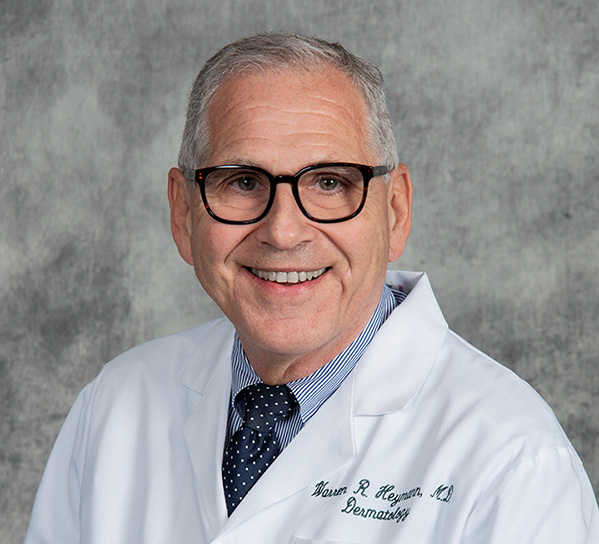
One of my greatest joys in dermatology is diagnosing a disease that I have only read about, but then encounter in life. That “aha moment” is exhilarating! When attending patient presentations at dermatology conferences, I encourage my residents not to look at the protocols first — this way they are unbiased and forced to reach their own conclusions. Last spring, at the Philadelphia Dermatological Society Meeting held at the Philadelphia College of Osteopathic Medicine, a two-year-old Pakistani girl with suprapubic and lower abdominal hypopigmented papules, confirmed histologically as clear cell papulosis (CCP), was presented. That was my clinical impression — I felt like Irene Cara singing “What a Feeling!”Keep reading!
Register for the Academy’s virtual meeting experience, AAD VMX
The Academy has developed a virtual meeting experience called AAD VMX that will be held June 12-14, 2020. Participants will join the Academy for a three-day live and online experience from the comfort and safety of their home and/or office. AAD VMX offers more than 27 CME credits, 14 robust sessions on multiple clinical topics, live Q&As with presenters, 900 posters, a virtual exhibit hall, and more! Register now.
COVID-19 dermatology registry qualifies as an Improvement Activity
CMS has confirmed the COVID-19 dermatology case registry is an acceptable registry for the attestation of the high-weighted practice Improvement Activity (IA), “COVID-19 Clinical Trials related to the Emergency Response & Preparedness,” under the Merit-based Incentive Payment System. Documentation requirements should remain available for at least six years in the event the eligible physician or group was asked by CMS to provide further information or validation of their performance. Learn more in the Quality Payment Program fact sheet. AAD members who need assistance with MIPS reporting or have questions can contact macra@aad.org.
Academy seeks assistant secretary-treasurer nominees
Applications and nominations are now being solicited for the position of assistant secretary-treasurer for the American Academy of Dermatology and AAD Association. The term begins March 2022. Daniel D. Bennett, MD, is the current assistant secretary-treasurer.
Members interested in serving the Academy in this position should have significant administrative and financial management experience. The position of assistant secretary-treasurer requires a considerable time commitment. Applicants must be able to serve for six years: three years as assistant secretary-treasurer and three additional years as secretary-treasurer.
To learn more about the position and apply, visit www.aad.org/AST. Applications are due Jan. 4, 2021. Questions may be directed to Cyndi Del Boccio in the AAD Executive Office at (847) 240-1041 or cdelboccio@aad.org.
COVID-19 skin care and hygiene kits for the homeless
DW Weekly spoke with Tufts University medical student Haya Raef, and Jennifer Tan, MD, dermatology faculty member at Massachusetts General Hospital, about their efforts to create COVID-19 skin care and hygiene kits for individuals experiencing homelessness in the Boston and Portland, Maine areas.
DW Weekly: Tell us how you got involved in this project.
Dr. Tan: The idea for the kits arose from a project that we’ve developed over the past year. Our patients experience the same common skin conditions that are seen in our general practices, including acne, eczema, and seborrheic dermatitis. Treatment for these conditions often at least partially involves use of over-the-counter products, which is a financial barrier for our patients. Thanks to generous donations and the work of Samantha Guhan, a Harvard medical student, and Neera Nathan, MD, a dermatology resident, we’ve designed diagnosis-specific kits to distribute in conjunction with a newly launched teledermatology initiative with the Boston Health Care for the Homeless Program (BHCHP).
Haya Raef: I was rotating with Dr. Tan at the BHCHP just before the coronavirus pandemic hit. Inspired by the diagnosis-specific skin care kits that Dr. Tan has been assembling, the idea of creating COVID care kits for individuals experiencing homelessness arose. The spread of COVID-19 has exacerbated many of the unique challenges that homeless communities already face. Patients are unable to socially distance and have limited access to hygienic supplies. We wanted to address the disparities that fall upon this population, by providing them with the necessities they lack. We reached out to BHCHP and the Preble Street Learning Collaborative (PSLC) to see if they would welcome the kits, and immediately got to work! Keep reading!
Academy Advisory Board invites members to submit policy resolutions
Do you have an issue of interest or area of concern? Now is your opportunity to submit a resolution from which an official Academy position might arise. Even if you do not have experience drafting resolutions, we encourage you to contact AADA staff Beth Laws or Cierra Martin, or members of the Advisory Board Executive Committee with ideas, and they will help guide you through the submission process.
To ensure consideration, all resolutions must be submitted by June 24. The author and/or their AB representative must submit an updated conflict of interest and a statement of support with their resolution for consideration by the full Advisory Board. The statement should state the reasons why the Advisory Board should adopt the resolution. The full Advisory Board will consider the submitted comments and resolutions and vote this summer.
Established Academy position statements can be found on the Academy’s website.
Advertisement
The American Academy of Dermatology is a non-profit professional organization and does not endorse companies or products. Advertising helps support our mission.